


Heads up: I earn a small commission if you buy through my links. I only write about what we actually use. Bobbie is not a sponsor and I have no relationship with them; everything about their can below comes from their own label and website.
I thought I was overthinking it.
Everyone said feeding takes time. Babies are gassy, babies cry, it settles down. Maybe. But by week eight I was dreading the next bottle, because I never knew how the hour after it would go. Arched back, legs pulled up, screaming that had nothing to do with hunger — and in the other direction three days of straining and diapers like little stones. We were on our fourth can. Each one said “gentle” on the front, and each one, when I finally flipped it over, started with corn syrup solids or maltodextrin.
So I stopped hunting for the best-rated formula and started reading panels instead. And that’s how Bobbie ended up in my cart. USDA organic, lactose listed first, no corn syrup, no palm oil, made in Ohio, shipped from inside the country. It was, genuinely, a better label than anything on my counter. I had the starter bundle open on my phone at 11 p.m.
Then I did the thing I now do with every can: I put its full ingredient list next to the other one I’d been circling, HiPP Dutch Stage 1, and read both, line by line.
What the two labels agree on
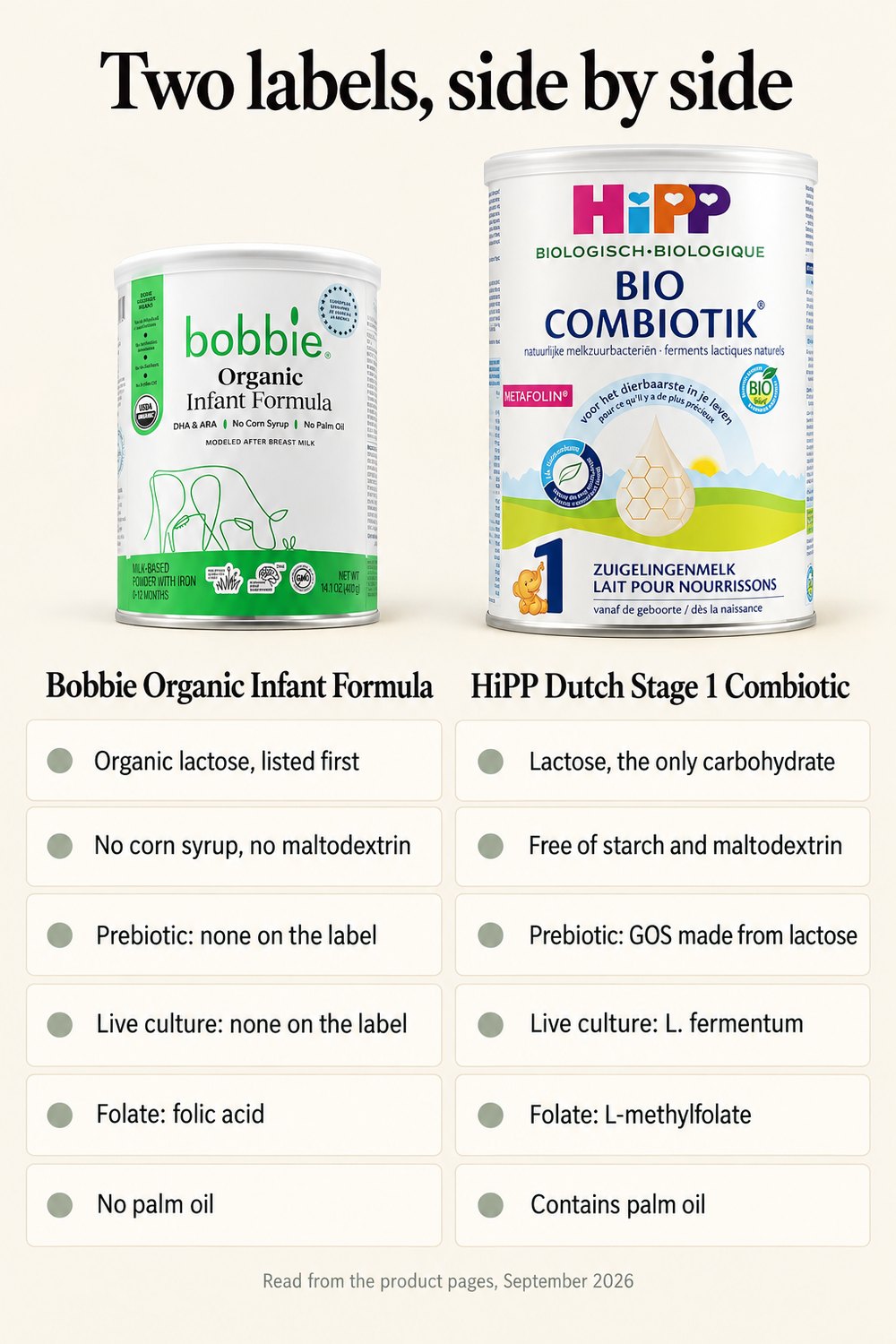
More than I expected. Both are built on lactose, the sugar breast milk is built on. Neither uses corn syrup solids or maltodextrin. Both use skim milk plus whey for the protein, both are organic (USDA on one, EU on the other), and both add DHA at about the same level: 20 mg per 100 calories on Bobbie’s panel (from algae), 13 mg per 100 ml on HiPP’s (from fish oil), which works out the same. If your only test is “no corn syrup,” they pass it together. (Bobbie also sells a whole-milk version now; I compared the original, the one most people mean.)
That’s exactly why I almost stopped reading there.
Where they part ways
Three lines further down, they stop being the same can.
The row that decided it for us
My test had boiled down to two questions: which sugar is the can built on, and is there anything living in it? Both cans pass the first. Only one lists anything for the second.
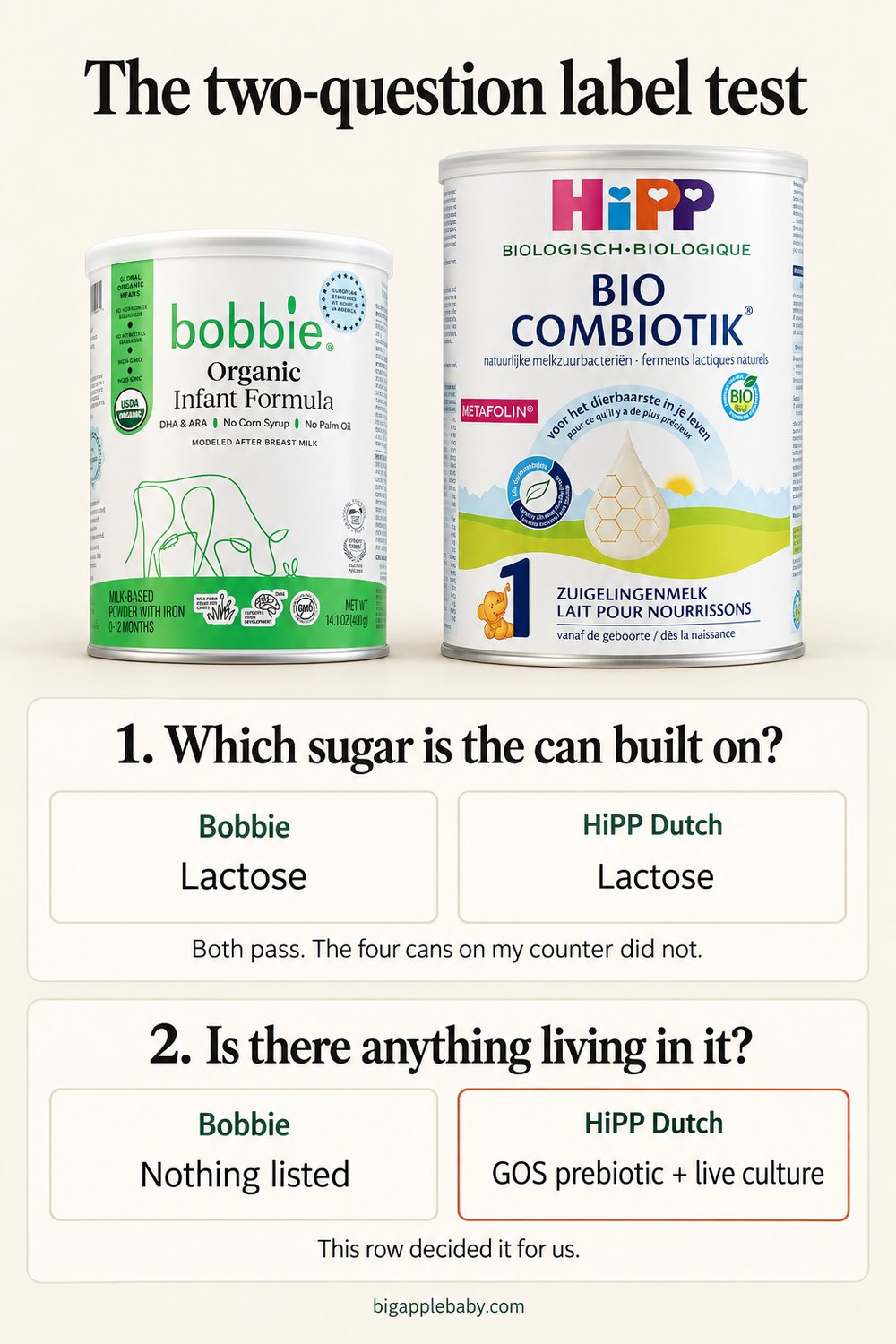
HiPP calls it “Combiotic”: a prebiotic, galacto-oligosaccharides, made from the same lactose the can is built on, paired with a living lactic-acid culture that HiPP describes as originally isolated from human breast milk. The sugar in the can is the sugar the culture in the can lives on. The way HiPP describes it, that pairing is the point: the can arrives with its own culture and the sugar it feeds on, instead of leaving that to chance. Bobbie’s list has neither a prebiotic nor a culture; if you want a probiotic, they sell it as separate drops. That’s not a flaw in their recipe, it’s a choice, and it’s printed right there. It just wasn’t the choice I was looking for.
Two smaller rows tipped the same way for me. HiPP Dutch uses calcium L-methylfolate, which Organic’s Best describes as the form of folate found in human milk, where Bobbie uses folic acid. And the Dutch recipe is staged: less iron in the 0-to-6-month can, a separate recipe from six months, and starch-free across every stage. Make sure it’s the Dutch box.
The rows that go to Bobbie
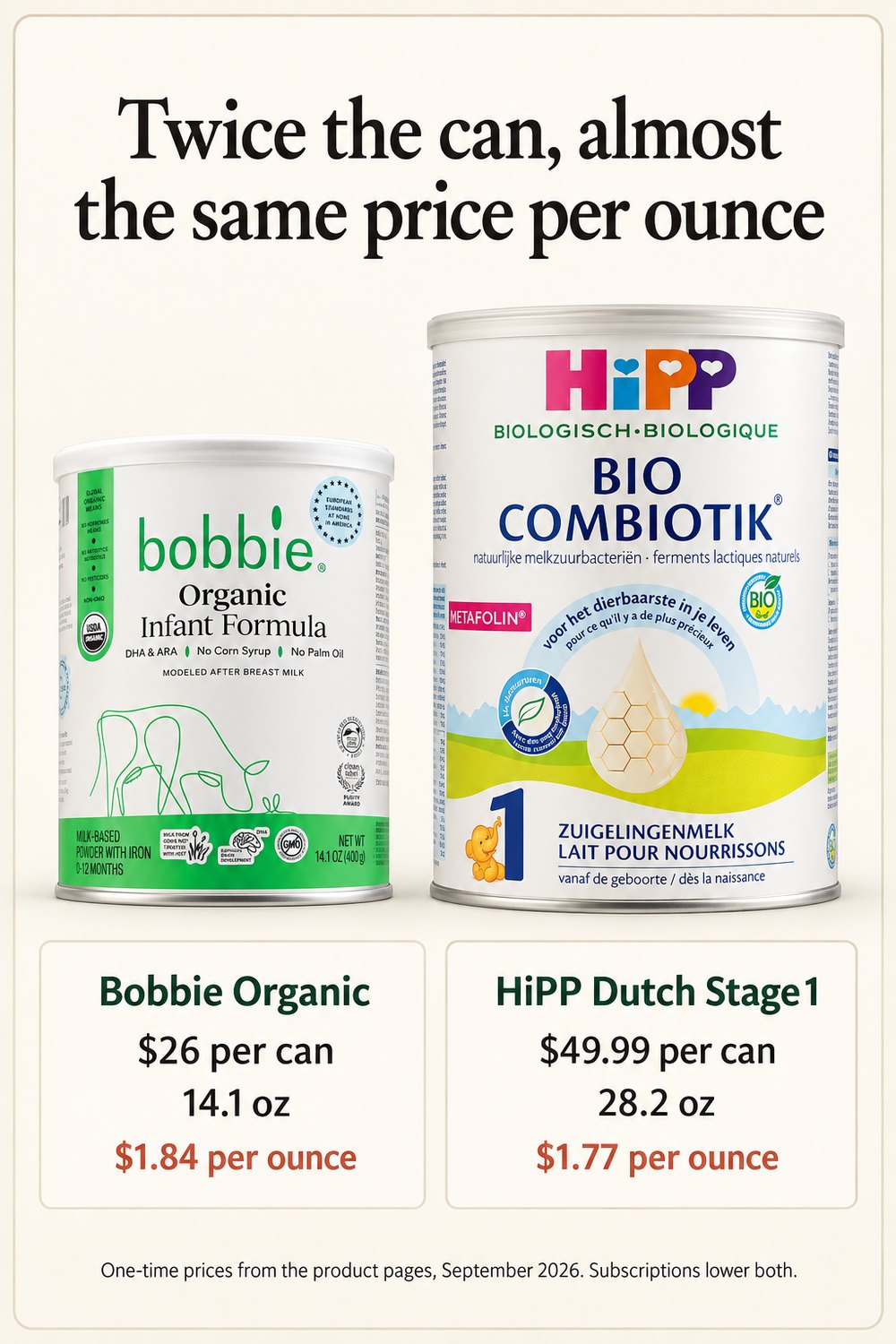
I’d be writing a dishonest article if I skipped this. Bobbie has no palm oil; HiPP does, and if that’s your line, Bobbie is the can. Bobbie is made in Ohio under FDA oversight and ships from inside the country; HiPP is made under EU rules, isn’t FDA-approved, and ships from Europe. Bobbie publishes more testing than any can I had on my counter: a Clean Label Project Purity Award and Pesticide-Free certification, a Light Labs screen for 550-plus contaminants with the results linked on the product page, and 2,000-plus checks per batch. Bobbie’s can costs $26 to HiPP’s $49.99, though the HiPP can is twice the size, so per ounce they’re a few cents apart. And Bobbie’s starter bundle comes with a 30-day money-back guarantee, no return needed.
Those are real advantages. I weighed them against one row, the living pair, and for us that row won. Yours might come out differently, and that would be a perfectly good decision too.
Two parents who’d read the same labels
“Baby loves the milk. He has regular bowel movements and no longer spits up. It really does act like breast milk; his stool is the colour and texture of an exclusively breastfed baby.”
Review on organicsbestshop.com
“Beautiful formula that has solved our daughter’s constipation issues. She sleeps much better, and I feel relieved knowing HiPP Dutch uses natural ingredients.”
Review on organicsbestshop.com
Two families, not a study. But relieved is the word I’d have picked too.
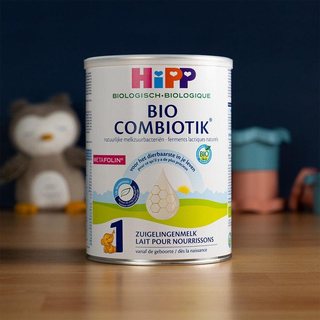
Where we landed: HiPP Dutch Stage 1
- Lactose as the only carbohydrate, no corn syrup solids or maltodextrin
- Free of starch and maltodextrin
- Combiotic: a prebiotic from that lactose plus a living culture
Ships from Europe, insured, in a few business days. If it turns out not to be your baby’s formula, Organic’s Best says they’ll send a gift card toward a different one.
What changed for us, and what didn’t
We ran the switch past our pediatrician first, and I’d tell you to do the same. Every baby is different and I’m one mom, not a study.
I closed the Bobbie tab and ordered a single HiPP can, fully expecting to be writing a different version of this paragraph. Day three, the straining let up. A week in, the evenings had shrunk from an hour of walking to about ten minutes of ordinary fussing, and his diapers had softened. I keep wanting to hedge that into nothing, so here is the honest version: I changed one variable, and that is what happened in our apartment.
I’m not dressing that up into a miracle. There were still nights I couldn’t explain; if a formula promises you a cured baby, that’s the promise I’d distrust. And I’ll say it plainly, because it’s true: breastfeeding is best for babies whenever it’s possible. This is for families feeding with formula anyway.
Before you click, the things I’d want to know
The honest part
It ships from Europe. Insured express delivery, a few business days door to door. That still means you order ahead or you run out; running out mid-week is a mistake you only make once.
A can is $49.99. It’s an 800 g can, twice a 14.1 oz Bobbie can, so per ounce the two land within a few cents. Ours lasted about a week at that age.
Is it FDA-approved? Organic’s Best says it plainly on their own FAQ: HiPP isn’t FDA-approved; it’s made and regulated under European food-safety rules instead. Read that page before you order.
It contains palm oil. Bobbie doesn’t. If that’s your line, you have your answer.
If it isn’t the one: the product page says that if a different formula is a better fit for your little one, they’ll send a gift card to try another box or can for free. A gift card, not a refund; they don’t take formula back once it’s shipped. Read their terms yourself.
The other end of this story
There’s a part I left out of the beginning. Theo nursed for exactly six weeks before my supply quietly packed up and left, and the first can on our counter was one I’d panic-bought on the way home. For two months I thought the hard evenings were the price of that. They weren’t. Reading two good labels side by side, instead of four I hadn’t read at all, is what finally let me set the whole thing down.
Put the two lists next to each other yourself. It takes five minutes, and you’ll know which row matters to you.
Check the ingredient panel at Organic’s Best
Lactose as the only carbohydrate, no corn syrup solids, no maltodextrin, a prebiotic and a live culture. The ingredient panel is on the product page. And always talk to your pediatrician before changing your baby’s formula.
A quick honest note: some posts here are sponsored, and Big Apple Baby earns a small commission when you buy through these links, at no extra cost to you. That income keeps the site running.