

Heads up: if you buy through these links, Big Apple Baby may earn a small commission, at no cost to you.
Hannah Reyes is the narrating character of Big Apple Baby. This story is a dramatization, composed from experiences parents have shared in reviews and online parenting communities, and it is not a testimonial by an identified individual customer. Images are illustrative and may use models or be digitally created.
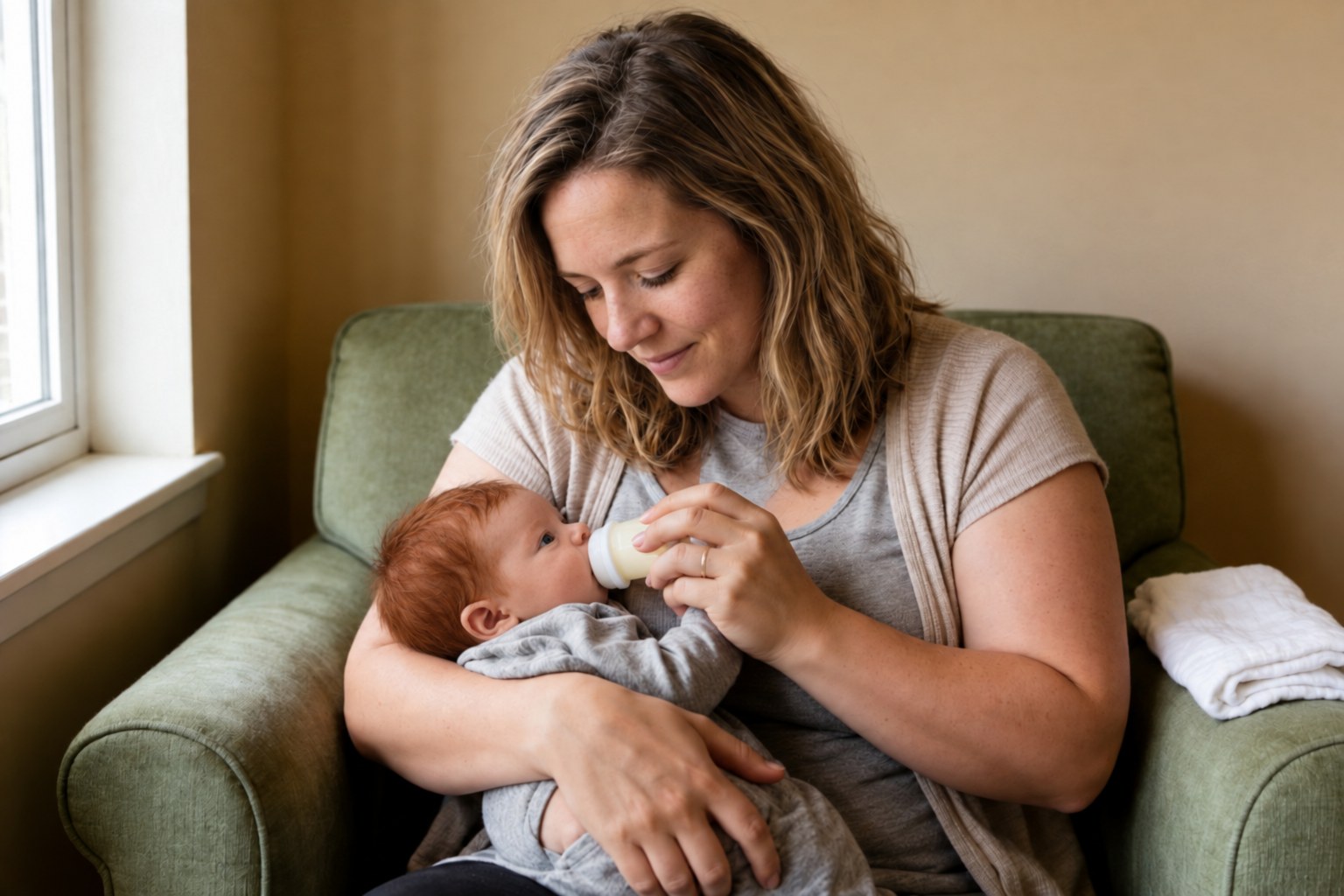
I’m not a doctor. I’m a mom who sat on the bathroom floor at three in the morning with a bottle in my hand and cried like I’d done something wrong.
Theo nursed for exactly six weeks. My supply was never much to begin with, and somewhere in that sixth week it quietly packed up and left. I did everything the internet swears by, the teas and the cookies and the 2 a.m. power-pumping while I watched the bottles fill a quarter inch and stop. None of it brought it back.
It didn’t end in one dramatic moment, either. For a while it was a couple of nursing sessions a day with formula filling the gaps. Then mostly bottles, with one morning nurse I wasn’t ready to give up. Then, eventually, all bottles. Nobody tells you that the last nursing session doesn’t announce itself. You only realize afterward that it was the last one.
So there I was with the formula I’d panic-bought, and every feed felt like a small apology. Like I was handing him a stand-in for the thing I was supposed to give him myself.
And then the hour after the bottle started going wrong. He’d take four ounces, and twenty minutes later he’d be arching off my lap with his legs pulled up, screaming in a way that had nothing to do with hunger. In the other direction, nothing — three, four days of straining, and when it finally came it was hard little pellets.
So the apology stopped being only about the milk. Every bottle felt like I was handing him the thing that was making his evenings hard, and I still had nothing better to hand him instead.
Short version: I wanted a formula built from the same building blocks as breast milk, not one that just said so on the front.
The one I found sits on the European shelf, not the American one. The rest of this is how I got there.
What I actually wanted, and couldn’t say out loud
I’ve written before about how long it took me to set that guilt down. This is the other half of that story, the part I was less willing to say at the time: I didn’t want “a good formula.” I wanted the closest possible thing to my own milk. Something that behaved like it, not just a can with a nice label and the word gentle on the front. And I wanted to stop feeling like the second-best option in my own kitchen.
Nobody would say that closeness was even a real thing you could shop for. The pediatrician’s office handed me a sample of the standard American stuff and moved on. Every brand promised “complete nutrition,” which is true, and also completely beside the point when what you’re grieving is the biology. I kept thinking there had to be a formula built to actually resemble what I’d lost, and I couldn’t tell if I was being precious about it or if it genuinely existed. Turns out it existed, and the one we landed on is not the one the sample bag was pushing.
The question I couldn’t put down
It stuck with me for weeks, this one question: is any of this really the next best thing, or am I just telling myself that so I can sleep?
I needed an actual answer, not a slogan. And the slogans were everywhere. “Breast-milk inspired.” “Modeled on nature.” Inspired by. Modeled on. Nobody would tell me how close, or by what.
Why the aisle let me down
We tried a few of the domestic “gentle” and “sensitive” ones before I went digging. I’m not going to name-and-shame anybody, because none of them are villains and plenty of babies do fine on them. They just weren’t it for us, and once I understood why, I couldn’t unsee it.
I did the thing I should’ve done first: I lined up the cans and read the first few ingredients on each. The ones I’d been reaching for mostly started with corn syrup solids or maltodextrin, sugars that are nothing like the lactose in breast milk, plus added starch to bulk things up. A lot of them had no live cultures at all. I’m not saying that makes them dangerous. I’m saying that if what you’re chasing is closeness to breast milk, these were built on a different foundation, and no amount of “gentle” on the label changes the foundation. (If you want the longer version of why the two shelves diverge, I went through it in European vs. American formula.)
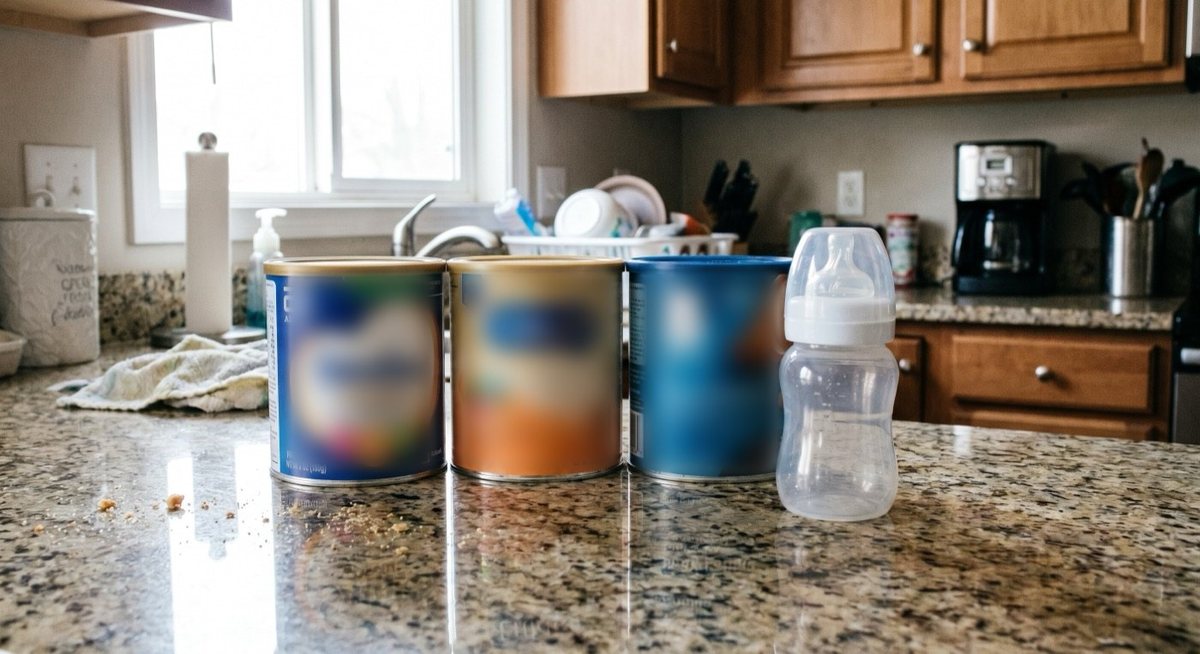
That was the moment it clicked for me. I hadn’t been failing to find the right formula. I’d been shopping the wrong shelf entirely.
What “closest to breast milk” actually has to mean
So I got specific, because “close” is meaningless until you say close how. Breast milk’s closeness lives in a few concrete things. Its sugar is lactose, not corn syrup. It carries living cultures and the prebiotics that feed them. It doesn’t lean on starch and fillers. If a formula misses those, it can call itself whatever it wants; it still isn’t built the way the real thing is.
What I’d been buying
- Corn syrup solids or maltodextrin listed first
- Added starch to bulk things up
- Often no live cultures at all
What breast milk is built on
- Lactose as the sugar
- No starch, no fillers
- Living cultures, plus the prebiotics that feed them
That reframe is the whole thing. It was never that formula couldn’t resemble breast milk. It’s that the one I actually needed had to be made from the same building blocks, and almost nothing on the standard shelf is.
The part that made me put my phone down
Then I found the detail that genuinely stopped me. There’s a European formula, HiPP’s Dutch Stage 1, whose probiotic culture HiPP describes as originally isolated from human breast milk. Not “inspired by” milk. Taken from it. A living culture, pulled from the one place I couldn’t be a source of anymore, and put in a can.
I sat with that for a second. “The closest thing to breast milk” had been marketing noise for months, and here it was about as literal as a can is ever going to get. HiPP pairs that culture with a prebiotic made from the same lactose the can is built on — the sugar in the can is the sugar the culture lives on. The way HiPP describes it, that pairing is the point: the can arrives with its own culture and the sugar it feeds on, instead of leaving that to chance.
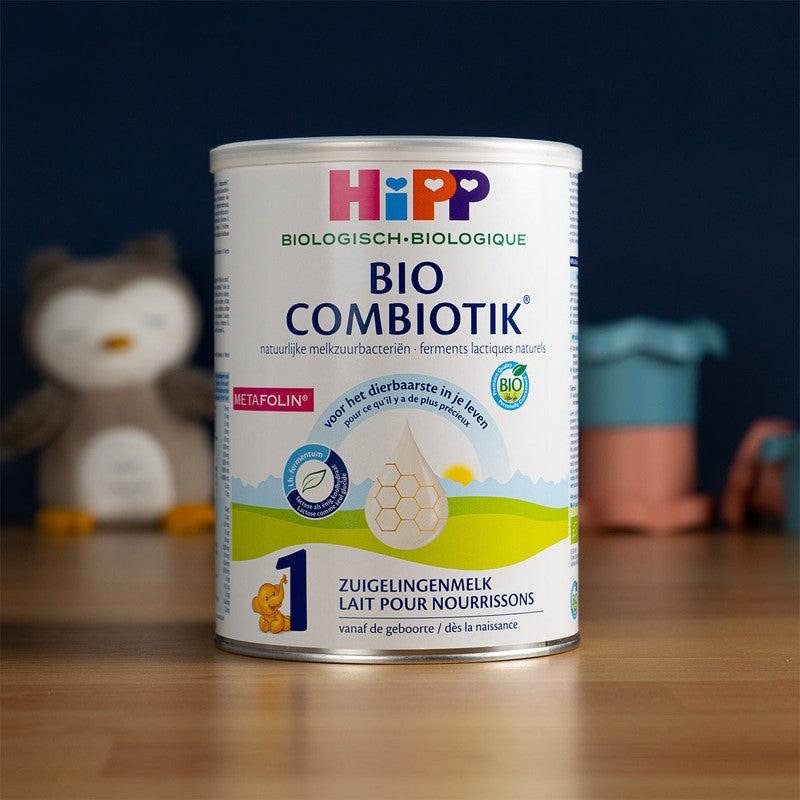
The rest of the HiPP Dutch Stage 1 label lined up with everything I’d just taught myself to look for:
- Lactose as the only carbohydrate: the same sugar as breast milk, with no corn syrup solids and no maltodextrin.
- Free of starch and maltodextrin: that’s stated plainly on the product page, which is exactly the sentence I’d been hunting for on every other can.
- A prebiotic and a probiotic together: galacto-oligosaccharides made from that same lactose, paired with the human-milk culture.
One thing worth knowing before you order: HiPP’s recipes differ by country, so check you’re getting the Dutch one and not a lookalike box.
Where we finally landed: HiPP Dutch Stage 1
- Lactose as the only carbohydrate, no corn syrup solids or maltodextrin
- Free of starch and maltodextrin
- A prebiotic and a probiotic together
Ships from Europe, so order before you run out.
What our first couple of weeks looked like
I want to be careful here, because every baby is different and I’m one mom, not a study. We ran the switch past our pediatrician first, and I’d tell you to do the same. Really. Rule out the things that need ruling out.
I ordered one can, half expecting it to end up under the sink with the others.
Day two, the straining stopped taking up the whole evening. By the end of that first week I caught myself not bracing when I picked up the bottle. His diapers went soft and yellow, the way they’d looked when I was still nursing, and that one undid me a little. Week two, he slept a four-hour stretch and I woke up before he did. That hadn’t happened since the hospital.
I’m not going to dress that up into a miracle. There were still evenings I couldn’t explain, and I know a different formula would have been the answer for a different baby. This is our timeline. It isn’t a promise of yours.
And the thing that shifted the most still wasn’t in him. It was in me. I stopped apologizing every time I made a bottle.
And I’ll say the obvious thing plainly, because it’s true and it deserves to be said: breastfeeding is best for babies whenever it’s possible. This is written for families who, like ours, ended up feeding with formula anyway, and wanted the closest thing to the real one we could find.
My honest take, caveats included
It’s not perfect, and I’d rather tell you the flaws than have you find them yourself.
Good to know before you order
It ships from Europe. That means you order ahead or you run out. More on that below.
It contains palm oil. That sends some parents running. For what it’s worth, it’s in there for palmitic acid, a real component of breast-milk fat, not as a cheap filler.
And it helped us; it didn’t fix everything. There were still fussy evenings and days I couldn’t explain. If a formula promises you a cured baby, that’s the promise I’d distrust.
What two other parents said
I wasn’t the only one chasing this. There are two reviews on the product page, and both are from parents who were after the same thing I was.
“Baby loves the milk. He has regular bowel movements and no longer spits up. It really does act like breast milk; his stool is the colour and texture of an exclusively breastfed baby.”
Review on organicsbestshop.com
“Beautiful formula that has solved our daughter’s constipation issues. She sleeps much better, and I feel relieved knowing HiPP Dutch uses natural ingredients.”
Review on organicsbestshop.com
Those are two families’ experiences, not a promise about yours or mine. Babies differ, and plenty of them do fine on something else entirely. But relieved is the word I’d have picked too.
If you’re where I was
If you couldn’t breastfeed, or couldn’t keep going, and you’ve been carrying that quiet sense that formula is a downgrade, I don’t think it has to be. Finding the one built to actually resemble what you were making is what let me set the guilt down.
HiPP Dutch Stage 1 is where I’d start. It ships from Europe, so order before you’re down to your last tin; running out mid-week is a mistake you only make once.
If it’s not the right fit
One thing that made me braver about ordering the first time: Organic’s Best says on the product page that if you decide a different formula is a better fit for your little one, they’ll send you a gift card to try another box or can for free. A gift card, not a refund. They don’t take formula back once it’s shipped, which honestly makes sense for something you feed a baby. Worth reading their terms yourself before you order.
Check availability at Organic’s Best
Always talk to your pediatrician before changing your baby’s formula.
A quick honest note: some posts here are sponsored, and Big Apple Baby earns a small commission when you buy through these links, at no extra cost to you. That income keeps the site running.