


Heads up: if you buy through my links I may earn a small commission, at no cost to you. I only recommend things we actually use.
It was 4:10 in the morning and I was on the bathroom floor with my phone, Googling “baby hasn’t pooped in three days hard belly” for the fourth time that night. Theo had finally fallen asleep on my chest. His little stomach was hard under his onesie. Not firm. Hard, like a small rock. I kept pressing it with two fingers the way the internet tells you not to, then feeling guilty, then doing it again.
I’m not a doctor. I’m a mom who spent about three months watching her son strain, go red, pull his knees to his chest and scream, and then not fill a diaper for days.
I’ve written about the switching itself before, and about what finally helped the gas and constipation. What I never really unpacked in either one is the part that took me longest to see: the thing I kept changing wasn’t the thing that mattered. This is that story, and it ends with the formula we eventually landed on.
What I wanted back then felt embarrassingly small: one normal diaper. Soft, unremarkable, mustard-yellow, the kind you don’t photograph or text your sister about. I wanted to feed my son and not spend the next two hours bracing for what came after.
Instead I had a spreadsheet where my brain used to be. Every feed, every ounce, every diaper, the color, the gap between them. I knew Theo’s gut better than I knew my own week. And still, most evenings ended the same way: the arched back, the grunting, and every few days the “booger diapers.” That’s the phrase I stole from another mom in a thread, and I’ve never found a better one.
The worst part wasn’t the mess. It was the quiet fear that I was the one doing this to him.
What we tried first, and why none of it stuck
We did what I think most people do. We started with the standard formula off the shelf, and when Theo struggled, we “graduated” to the gentle one. Then the sensitive one. Then the added-rice-starch one that’s supposed to help with spit-up. Our pediatrician was kind and told us to give each switch a couple of weeks, so we did. Five formulas, about three months.
I also went down the add-ons road. Probiotic drops in the bottle. Gripe water. Warm baths, bicycle legs, that little thermometer trick nobody enjoys. A few of these bought us a slightly better night here and there. None of them changed the actual pattern.
Here’s the thing I only understood later, and it’s the reason I’m writing this one at all. Every one of those “gentle” and “sensitive” cans was built on the same base. I don’t want to name-and-shame a specific brand, because honestly they’re more alike than different. But if you turn the can around, the American “sensitive” formulas tend to lean on corn syrup solids, maltodextrin, and added starch. Swapping one for another was like changing the label on the same bottle. I was changing the brand name five times and never once changing the ingredient.
It was never his tummy. It was the recipe.
So I stopped shopping and started reading, and the thing that reframed it was almost too simple.
A baby doesn’t eat a variety of things. Formula is the entire diet, and the carbohydrate is the biggest part of it after the milk itself. That one line on the panel is the backbone of everything your baby takes in all day. And on every can I’d tried, that line was corn syrup solids, or maltodextrin, or starch. Different fronts. Same backbone.
I’m not a scientist and I’m not going to pretend I proved anything in my kitchen. But I’d spent three months changing the variable that didn’t matter. The one variable I had never actually changed was the sugar. So that’s the one I decided to change, on purpose, and see.
That was the whole 2 a.m. rabbit hole. European formula, and specifically the idea that you could make infant formula without the corn syrup, without the maltodextrin, without the added starch, and put back the things a gut actually wants.
And I need to say this plainly, because I needed to hear it myself: none of it meant I was a bad mom. It was what was in the can.
The part that actually made the difference for us
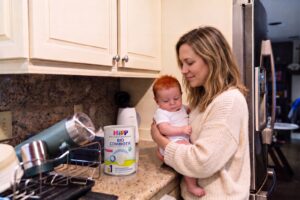
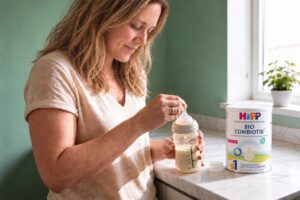
The formula we ended up using is HiPP Dutch Stage 1. Two things about the label mattered to me.
First, the only carbohydrate on it is lactose, the same sugar that’s in breast milk, and the product page says outright that it’s free of starch and maltodextrin. That’s the sentence I’d been trying and failing to find on every other can I’d picked up. The thing I wanted out simply wasn’t in there.
Second, and this is the part I hadn’t seen on any drugstore shelf, it pairs a prebiotic made from that same lactose with a live culture that HiPP describes as originally isolated from human breast milk. In normal-person terms, one ingredient feeds the good gut bacteria and the other is the good gut bacteria. The gentle formulas I’d tried took things out, at best. None of them put anything back.
One practical note, since I got this wrong at first: HiPP’s recipes differ by country, so check you’re actually getting the Dutch one.
Where we landed: HiPP Dutch Stage 1.
What changed for us, and the honest caveats
I’m not going to hand you a timeline, because I hate when people do that. Every baby is different, and I’m not a doctor. We ran the switch past Theo’s pediatrician, and I’d genuinely tell you to run any formula change past yours. I’ll also say the thing that happens to be completely true: breastfeeding is the best nutrition for a baby. This is for those of us who, for a hundred different reasons, are feeding formula anyway.
For us, over the following week or so, the diapers stopped being an event. That’s the most honest way I can put it. The evenings got quieter. I stopped photographing diapers. I can’t tell you it will go that way for your baby, and I’d be suspicious of anyone who did.
Now the caveats, because I promised myself I’d always include them.
It’s not cheap. A can runs around $50, which is more than the drugstore stuff, and I won’t pretend otherwise. It also ships from Europe, so you’re not grabbing it on a Target run. And yes, if you read labels obsessively like I do: it does contain palm oil. That threw me at first, until I read that palm oil is a source of palmitic acid, which is also one of the main fats in breast milk. For us it was a non-issue, but I’d rather you hear it from me than feel ambushed by the ingredient list.
What two other parents said
I can really only speak for Theo. But when I was stuck in the deciding-and-doubting phase, reading other parents was what tipped me. There are two reviews on the product page, and here they are in full:
Lourdes M.: “Baby loves the milk. He has regular bowel movements and no longer spits up. It really does act like breast milk; his stool is the colour and texture of an exclusively breastfed baby.”
Tony U.: “Beautiful formula that has solved our daughter’s constipation issues. She sleeps much better, and I feel relieved knowing HiPP Dutch uses natural ingredients.”
Those are two families’ experiences and nothing more. Every baby responds differently, plenty do fine on something else, and neither of those parents is describing a treatment. But reading a stranger describe the exact diaper I was praying for is the reason I finally ordered.
Where I get it
I buy it from Organic’s Best, which is where I landed after being nervous about counterfeit tins and customs. They ship insured express, usually a few days.
The thing that actually let me hit “order” the first time is on their product page: if you decide there’s a better formula for your little one than this one, they’ll send you a gift card so you can try a different box or can for free. A gift card, not a refund. They don’t take formula back once it’s shipped, which for something you feed a baby is fair enough. Read their terms yourself before you order, but for a can I was buying sight-unseen from across an ocean, knowing I wouldn’t be stranded with a single choice was enough.
If you’re where I was, on the floor at 4 a.m. with a hard little belly and a diaper app you check too often, this is where I’d start. Not because it’s magic. Because it finally let me change the one thing I’d never changed. Order a little before you run out, since it comes from Europe, and give your baby’s gut a minute to catch up.
This is an advertisement and contains affiliate links. Breastfeeding is best for your baby. This is one mom’s experience, not medical advice — please talk to your pediatrician about your baby’s needs.
Keep reading

A quick honest note: some posts here are sponsored, and Big Apple Baby earns a small commission when you buy through these links, at no extra cost to you. That income keeps the site running.