
For about three months, the soundtrack of our apartment was Theo crying through his feeds. Not regular newborn fussing. The kind where he’d arch his back, yank off the bottle, ball up two tiny fists, and scream like something genuinely hurt. Because something did. He was gassy, he was constipated, and I was running on no sleep and a truly impressive amount of guilt.
I’m writing this down because I spent weeks googling some version of “baby screaming during feeds gas constipation” at 3 a.m., and almost everything I found was either terrifying or trying to sell me something by the second sentence. So here’s just what happened with us, in order, with nothing to pitch.
Everything we tried first (and why none of it stuck)
We did the whole tour. Gas drops before every feed. Gripe water. Bicycle legs at 4 a.m. The clockwise tummy massage. Warm baths. Holding him upright for what felt like an hour after every bottle. Some of it bought us one calmer night, then quit on us.
Then we started switching formula, because everyone says the same thing: “it’s probably the formula.” A standard gentle one made him spit up more. A sensitive, lower-lactose one looked promising for about four days before the crying marched right back. A friend swore by goat milk formula, so we tried it, and somehow he got more backed up, not less. At one point we were on a hypoallergenic formula that cost forty dollars a can and lasted maybe four days.
I remember sitting on the bathroom floor doing the math on that one and just crying. We were spending a small fortune to rent a few quiet days at a time, and nothing was actually getting better.
The thing that finally clicked
I stopped asking “which brand is gentle?” and started asking “what is actually in the bottle?” That sounds obvious written down. It was not even slightly obvious at six weeks postpartum on three hours of sleep.
When I finally started reading labels properly — I wrote a whole separate post on how to do that without losing your mind — I noticed every formula we’d cycled through had one thing in common. The carbohydrate wasn’t just lactose. Most of them leaned on corn syrup solids, or maltodextrin, or a little starch. A newborn’s gut is really only built for lactose, the sugar in breast milk. Those other carbs sit heavier, and for Theo they meant gas and hard stools every single time.
So I hadn’t been failing at five different problems across five cans. I’d been making the same mistake five times.
What actually helped, honestly
Two things made the real difference for us, and I want to be clear up front: this is our experience, not medical advice. Please talk to your pediatrician, especially if there’s pain, blood, or any worry about weight.
First, we moved to a formula where the only carbohydrate is lactose. No corn syrup solids, no maltodextrin, no starch. As close to the sugar in breast milk as a bottle gets.
Second, that same formula happened to include prebiotics and a probiotic, the things a gut uses to settle itself in. I started picturing his digestion like a brand-new garden: it needs the right bacteria to move in, and a bit of food to convince them to stay.
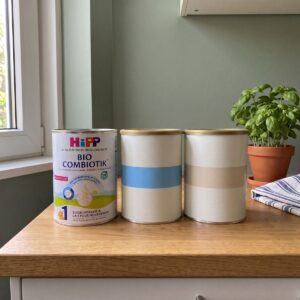
The first thing I noticed on that first bottle wasn’t his stomach. It was that he drank without fighting me. A few days later, his diapers changed, softer and more yellow, exactly the way other moms had described and I hadn’t quite believed until I saw it myself. Which formula we landed on, and where I actually buy it, is its own post, because that part got long too.
If you’re in the thick of it right now
I’m not going to promise you a miracle, because I stopped believing in those somewhere around can number four, and you’ve been promised enough. But if your baby fights every feed and you’ve already switched more times than you can count, flip the can over and read the carbohydrate. It might not be the brand you keep changing. It might be the sugar inside it.
And please, go easy on yourself. The fact that you’re awake at 3 a.m. reading about your own baby’s digestion is proof that you’re doing the work. It does get quieter. Ours did.