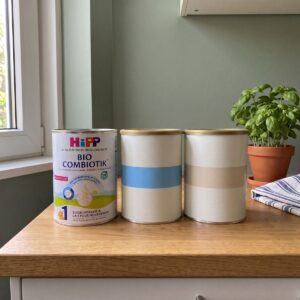
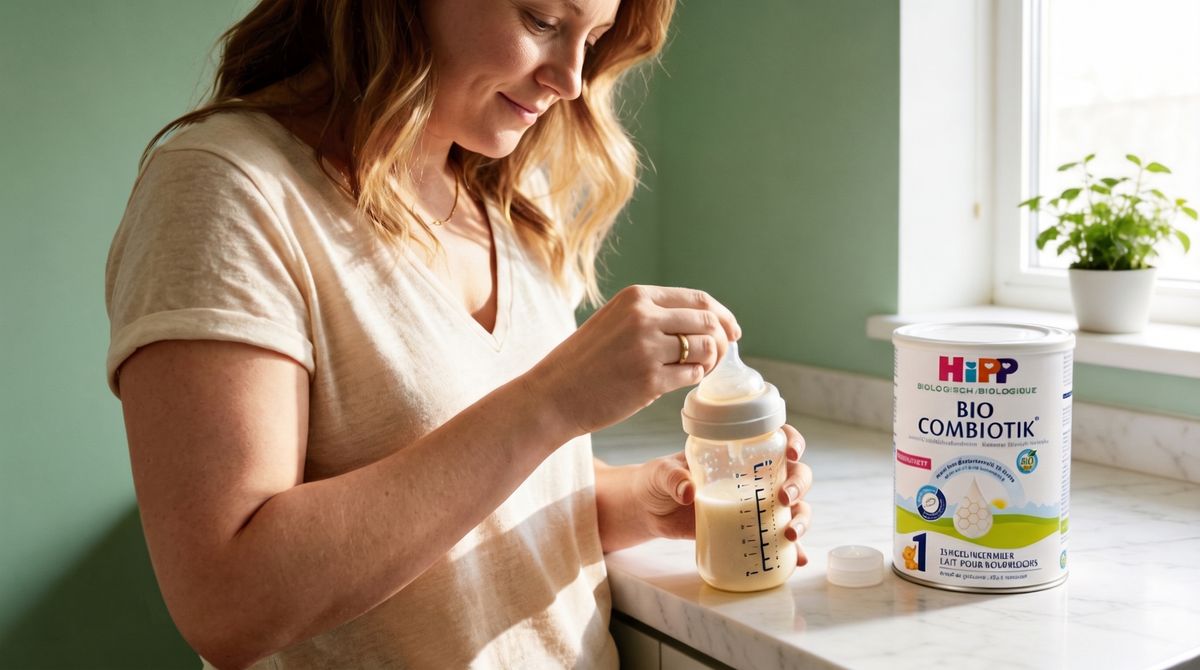
For Theo’s first two months, my formula-shopping strategy was simple and, looking back, a little embarrassing: flip the can over, see a wall of words I couldn’t pronounce, decide the brand with the nicest packaging probably had it handled, and get on with my day.
Then we hit the stretch where every feed ended in tears — his, and by week six, mine too — and I started reading the back of the can at 2 a.m. like it was a thriller I couldn’t put down. Here is everything I wish someone had walked me through before I lost it in the formula aisle.
The front of the can is an ad. The back is the truth.
“Gentle.” “Comfort.” “Sensitive.” “Tummy.” Those words live on the front of the can, and not one of them is regulated the way you’d hope. They’re marketing, not promises. The back is where the real information hides, and the rule there is simple: ingredients are listed by weight, the most of it first.
So the first thing I look at now is that opening ingredient. On most standard formulas it’s some form of cow’s milk, which is exactly what you want to see. On a few of the “sensitive” and “gentle” ones, what jumps out instead is a sweetener I wasn’t expecting.
The sugar question no one flagged for me
Breast milk runs on one main carbohydrate: lactose. That’s the sugar a brand-new belly is actually built to process. So when I read a label now, I’m really only chasing one answer: what is the carbohydrate in here?
Plenty of US formulas, the “sensitive” lines especially, trade some or all of that lactose for cheaper carbs. The ones I taught myself to spot:
- Corn syrup solids. Glucose from corn, basically, and oddly common in formulas marketed as “sensitive.”
- Maltodextrin. A starchy filler carbohydrate.
- Brown rice syrup and other syrups. These turn up in some organic options too, so “organic” on the front doesn’t guarantee lactose-based on the back.
- Plain starch, sometimes added to thicken things for reflux.
Let me be fair: none of these are poison, and plenty of babies handle them completely fine. But in our house, every single time we landed on something with corn syrup solids, Theo was gassier and more backed up. Once I knew the word, I couldn’t un-see it on a label again.
The other things I started checking
After the carbohydrate, my eyes drift to a few more lines. Palm oil is used to mimic a fatty acid in breast milk, but it firms some babies up, so I note it when constipation is the battle we’re fighting. I check whether there’s anything in there for the gut, a prebiotic like GOS or a probiotic strain, because plenty of formulas have none at all. And yes, I now clock the form of folate, which tells you exactly how far down this rabbit hole I went.
What I actually do in the store now
I don’t stand in the aisle for forty minutes anymore. I flip the can, find the carbohydrate line, and ask one thing: is this lactose, or something cheaper? Then I glance at whether there’s anything for the gut. That’s the whole ritual. Two questions, about ninety seconds.
It sounds almost too simple to matter, but that one habit changed everything for us. I stopped picking formula by the brand on the front and started picking it by the sugar on the back. If you want the long version, the trial and error and the can that finally worked, I wrote about how that played out for Theo separately, because it got long.
You really don’t need to turn this into a second job. But next time you’re holding a can at 2 a.m., wondering why nothing’s working, flip it over. The answer to a lot of rough feeds is usually sitting right there on the back.