A quick honest note from me: some posts here are sponsored, and yes, I earn a little when you buy through my links, at no extra cost to you. But I only ever write about things I actually use and believe in for my own son, Theo. That little bit of income is what keeps Big Apple Baby running and lets me put out more honest, useful content for you. So, thank you. 💜
I’m not a doctor. I’m a mom who spent three months watching her son cry — and then went down the rabbit hole that ended it.
Last month I woke up at 4:30 a.m. in a mild panic, because nothing had woken me. I stood over the crib for a full minute watching Theo sleep — fists unclenched, belly soft, breathing those long unbothered breaths. Then I went back to bed and cried a little, quietly, into my own pillow.
That silence took us three months and four formulas to find. If you’re reading this at 3 a.m. with a screaming baby on your chest, this is everything I wish someone had handed me back then.
The part nobody warned me about
Everyone tells you newborns cry. Nobody tells you about the other thing — the back-arching, leg-pulling, red-faced screaming that starts around week three and doesn’t respond to anything you were taught in the baby class.
Our nights looked like this: feed at midnight, screaming by one. My son would finally pass out on my chest, then jolt awake choking on his own spit-up. His diapers went from normal to nothing — three, four days of straining, and when something finally came, it looked like little pebbles. One mom on Reddit described her baby “pooping hard rocks and struggling,” and I have never felt so seen by six words.
We had a whole gas-relief station on the changing table. Drops before feeds. Bicycle legs. The little tube device I swore I’d never use — we used it daily.
And underneath the logistics, the quieter thing: I felt like I was failing at the one job that mattered. Our pediatrician was kind but unworried. “Some babies are just gassy. It usually passes.” I’d nod, go home, and google is colic forever with one thumb while he screamed in the other arm.
We tried everything in the formula aisle
Here’s the part I want you to hear, because I needed to hear it: we did not pick bad formulas. We picked the formulas everyone picks.
We started with the standard one from the hospital. When the gas got bad, we switched to the “gentle” version — same brand, softer-sounding label. Two decent weeks, then it all came back. So we escalated to the expensive hypoallergenic one our pediatrician suggested as a next step. My son took one taste and refused the bottle entirely. (We ran every single switch by our pediatrician first, and I’d tell you to do the same.)
Somewhere around can number four, exhausted and a little unhinged, I did something I’d weirdly never done: I lined the cans up on the counter and read the first five ingredients on each.
They were almost identical.
The 2 a.m. comment that changed everything
The discovery didn’t come from a doctor or a baby book. It came from a stranger in a Reddit thread, somewhere past 2 a.m.: a mom whose baby’s story sounded exactly like ours, saying the thing that finally worked for them was a European formula — and that the difference wasn’t marketing, it was regulation.
I was skeptical. I’d been burned by the word “gentle” already. But I’m a read-the-fine-print person by temperament, so instead of ordering anything, I went down the rabbit hole: actual EU regulations, formula ingredient lists, testing reports. The whole thing.
What I found genuinely surprised me.
What’s actually different about European formula
The short version: the European Union requires that lactose — the sugar naturally found in breast milk — be the primary carbohydrate in infant formula. U.S. rules don’t have that requirement. American formulas are held to different standards, and those standards allow the cheaper carbohydrates — corn syrup solids, maltodextrin — that I kept finding in our cans.
Here’s the part that finally reframed three months for me, because it’s the part nobody had explained. A newborn’s gut is built to run on lactose — it’s the sugar in breast milk for a reason, and from everything I read, it’s what tends to keep things moving and stools soft. The cheaper carbohydrates that stand in for it — corn syrup solids, maltodextrin, added starch — aren’t a match for that immature system in the same way; the explanation that finally made sense to me was that they sit heavier and bind harder, which is exactly the straining and the pebble-diapers we’d been living through. I’d spent three months convinced something was wrong with my son’s tummy. It wasn’t his tummy. It was the recipe his tummy was being handed.
That was my lightbulb. Not that anyone was doing anything illegal. Just that the recipes I’d been cycling through were all built on the same foundation, and there was an entire category built on a different one.
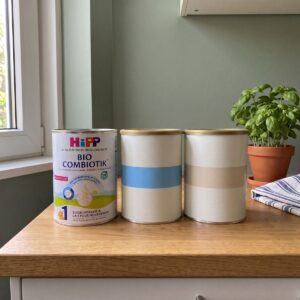
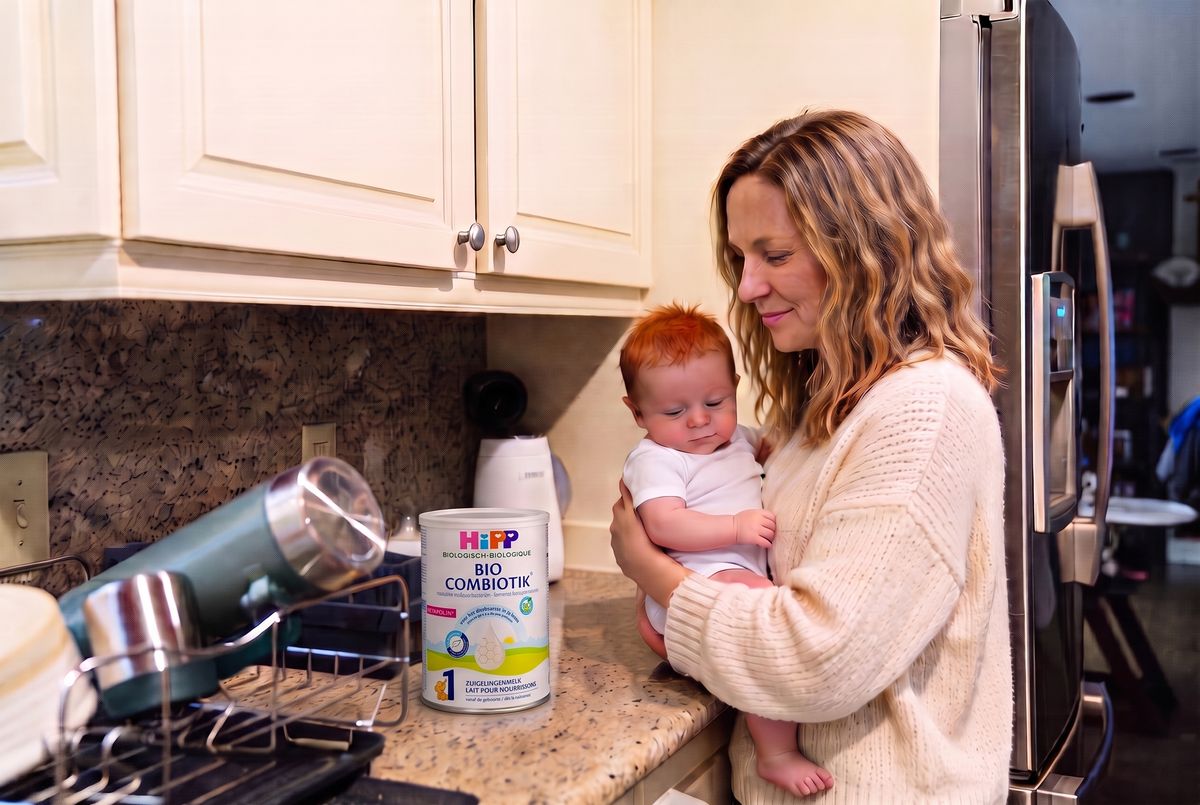
The formula we landed on — HiPP Dutch Stage 1 — takes it further than most, which is why I’m specific about the Dutch version (the German and UK ones are actually different recipes):
- Lactose only. No corn syrup solids, no maltodextrin, no added starch — the Dutch Stage 1 is the strictest of the HiPP family on this.
- Prebiotics plus a probiotic culture. This is the detail that got me: a lactic acid culture originally isolated from real breast milk. The idea, as HiPP describes it, is to support the gut the way breast milk does, not just to avoid irritating it. There’s a clinical study on that specific culture showing noticeably fewer tummy troubles in formula-fed infants; it was done with C-section babies, so the usual caveat applies. But it’s real research, not a marketing line.
- A 60:40 whey-to-casein ratio, modeled on early breast milk.
I’m not here to tell you European formula fixes anything — no formula is medicine, and every baby is different. What I can tell you is what the label says, what the regulations require, and what happened in our apartment.
What our first two weeks actually looked like
I ordered one can, fully prepared to add it to the graveyard.
Day two, the straining eased. By the end of the first week, the violent post-bottle screaming had wound down to regular baby fussing — a difference you only appreciate after months of the other kind. His diapers turned soft and yellow again, which I now know is the thing the mom forums mean when they talk about “breastfed-looking” diapers. By week two, we had our first real stretch of unbroken night sleep since he was born.
For us, it was roughly a week to a real difference. Some parents online describe it faster — one wrote “He was a new baby after 24 hours,” which I’d have rolled my eyes at three months ago. Some describe it slower, and for some babies a different formula entirely is the answer. I’m sharing our timeline, not promising you one.
What other parents (and the testing) say
I kept researching after we switched, partly out of habit and partly because I wanted to know I hadn’t just gotten lucky.
The parent reports cluster around the same themes we lived: the gas easing, the diapers normalizing, the spit-up calming down. One mom wrote that her daughter “no longer wakes up screaming from gas and pain.” Another, after a switch from a mainstream brand: “spitting up much less.”
On the safety side — because I know the next question, it was mine too: HiPP carries the EU organic seal, plus its own internal standard that’s stricter than the EU baseline. When Consumer Reports tested formulas for heavy metals, HiPP came back with undetectable levels. That’s the kind of sentence I don’t extrapolate from; I’ll just say it held up to the most paranoid version of me.
And the import question. Buying European formula from the U.S. is legal for personal use — what matters is the retailer. I order ours from a U.S.-based specialty shop that ships from climate-controlled warehouses in Europe, stocks directly from the manufacturer, and prints the expiration date right into the bottom of the tin (a printed date, never a sticker, is one of the authenticity checks I learned to look for). Delivery takes a few days, which brings me to the honest part.
My honest take — caveats included
After three months and four formulas, the Dutch Stage 1 is the one we kept. But I’d be writing a very different kind of article if I skipped the drawbacks:
- It costs more. About $50 a can ordered individually, less with bundles. A can makes roughly 44 bottles, which is how I made peace with the math — but it’s real money.
- It ships from Europe. A few days, in our experience. Order before you’re down to your last tin. Ask me how I know.
- The tins dent. Ours have arrived dinged more than once. Cosmetic, the seal’s what matters — but the first time, I panicked.
- The prep is fussier. The water needs to be in a specific warm range — hot enough to mix, not so hot it kills the probiotic cultures, which are the point. It’s an extra minute at 3 a.m. I decided the extra minute was worth it.
One more thing that mattered to me as a four-formula veteran: the retailer we use has a guarantee where, if your baby refuses the formula, they make it right with a credit toward a different one. After watching my son reject a $55 can of hypoallergenic formula in one sip, that policy is the only reason I felt safe ordering the first time.
If you’re where I was
Talk to your pediatrician — really. Rule out the things that need ruling out.
But if you’ve done that, and you’ve cycled through the “gentle” aisle, and you’re standing in the kitchen at 3 a.m. wondering whether it’s you: it might just be the recipe. It wasn’t you. It was never you.
If your little one has a sensitive tummy and you’ve already been through the big-brand carousel, HiPP Dutch Stage 1 is where I’d start. One practical thing: it ships from Europe, so order before you’re down to your last tin — running out mid-week is the mistake you only make once. Quiet nights are worth a dented tin.
Breastfeeding is best for babies whenever it’s possible — this is written for families who, like ours, are feeding with formula. Every baby is different, and this is our family’s experience, not medical advice. Questions about feeding, switching, or symptoms belong with your pediatrician.