
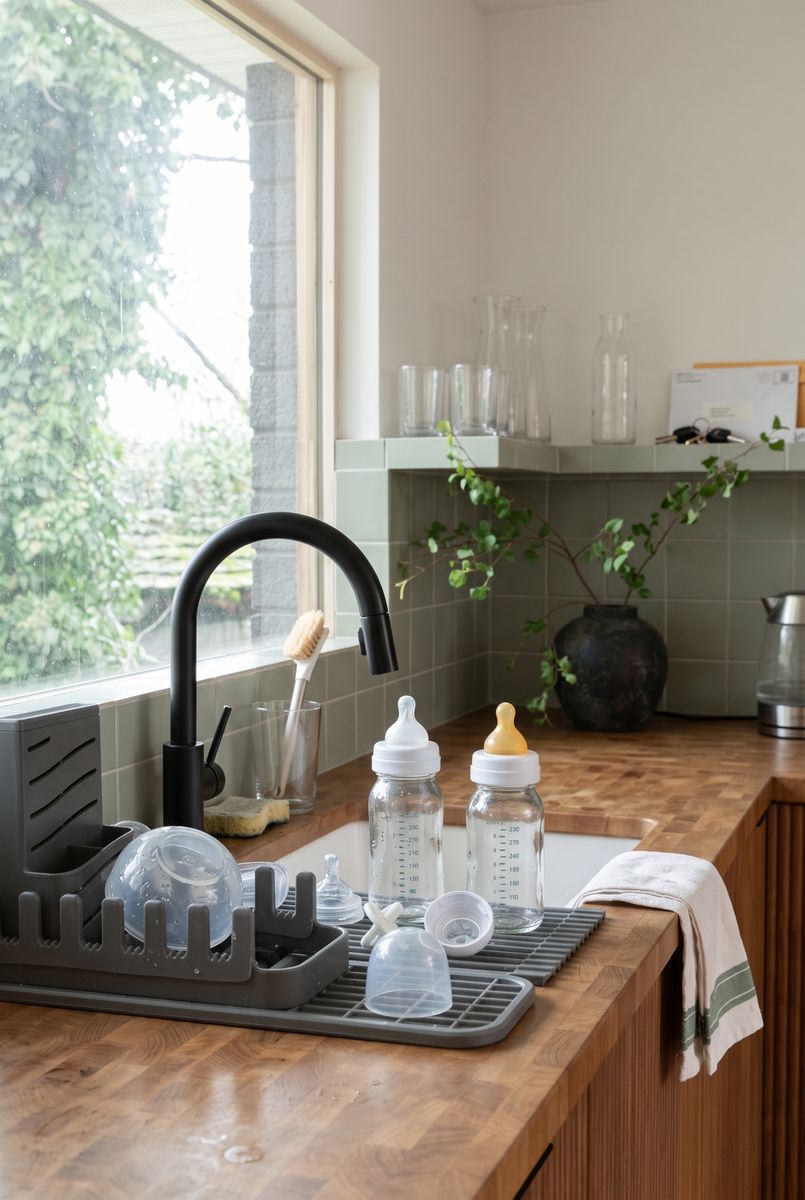
I did not expect to become a person with opinions about baby bottles. And yet here I am, having tested what felt like every bottle sold in this city, all because Theo spent his first few months gassy, refluxy, and furious during feeds. The bottle turned out to matter more than I ever would have guessed. Not as much as what went in it, but more than enough to be worth getting right.
Quick honesty before we start: a bottle is not a cure. The biggest change for us came from sorting out the formula itself, which I wrote about in what actually helped Theo’s gas and constipation. But once we had the right formula, the right bottle is what finally stopped him swallowing a stomach full of air at every feed. Here’s what I learned scrubbing all of them.
What I was actually looking for
After a lot of trial and error, my checklist for a gassy, refluxy baby came down to four things:
- A real venting system: a tube or valve that gives the air somewhere to go besides the baby’s stomach.
- A slow-flow nipple in the right size for his age. Too fast a flow made the choking and the spit-up dramatically worse.
- A nipple shape he’d actually accept without a fight, which is maddeningly individual from one baby to the next.
- Parts I could clean at 11 p.m. without an engineering degree. Some “anti-colic” bottles have five pieces each. Multiply that by a day of feeds and you will lose your mind.
The vented bottles
The multi-piece vented bottles — the ones with the internal straw system — genuinely helped his gas. The trade-off is the cleaning. They work, but you pay for it in parts and in time at the sink. For a truly gassy baby, I thought the trade was worth it for the first few months, and then we simplified once his system matured.
The angled and wide-neck bottles
An angled bottle kept the nipple full of milk instead of air, which mattered a lot for reflux. And a wide-neck bottle was easier for Theo to latch onto coming off the breast during our combo-feeding stretch. If you’re going back and forth, that shape transition is real, and I got into it more in my post on combo-feeding.
The part no bottle box mentions
Here’s what surprised me most: how you feed matters as much as what you feed from. Paced bottle feeding (holding him more upright, keeping the bottle closer to level, taking deliberate breaks) cut his gas more than swapping bottles ever did. A fancy anti-colic bottle tipped straight up still pours air into a baby. The technique is free, and it’s the most underrated thing on this whole list.
What I’d tell a fellow reflux parent
Don’t buy six of one bottle before you know your baby likes it. Buy one each of two or three styles, run them for a few days, and let the baby cast the deciding vote. And keep the order of operations straight: get the ingredients right first, then the formula, then the bottle, then the technique. We chased the bottle for weeks when the real problem was sitting in the powder. The whole story of how we figured that out is its own post.
The right bottle didn’t fix everything on its own. But paired with the right formula and a slower, more upright way of feeding, it turned feeds back from a battle into the quiet, sleepy thing they were always supposed to be. That was worth every weird little tube I had to scrub.