
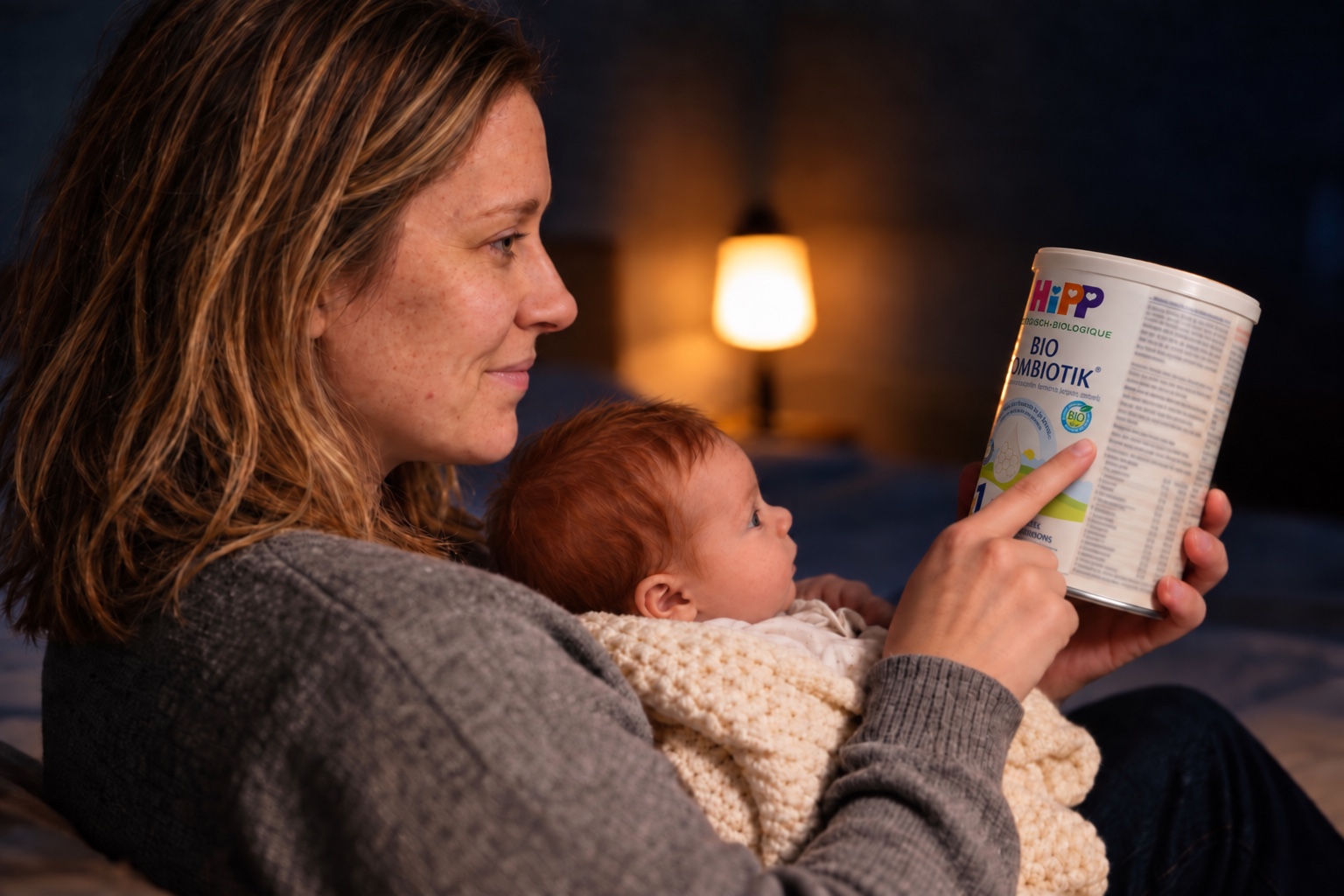

What I found the night I finally read the whole ingredient panel instead of the front of the box.
Heads up: if you buy through my links I may earn a small commission, at no cost to you. I only recommend things we actually use.
I read the fine print on everything. Leases, the sunscreen ingredients, the sneaky auto-renew on a yoga app. It’s a personality flaw my husband has learned to wait out in grocery aisles.
Which is why this one still stings a little. I spent about three months reading formula cans and I was reading them wrong the entire time.
I was reading the front. The brand name, the word on the label, whether it said gentle or sensitive or comfort. I was comparing boxes to other boxes. And every few weeks, when nothing improved, I’d pick a different box and start again. What I never did, not once in three months, was turn the can around and read the carbohydrate line all the way down.
Then one night, warming a bottle at some ugly hour, I did. All of it. The way I’d read a lease. And I couldn’t un-read it. That was the night I started paying attention to what I now feed him, the one we ended up with, but I want to walk you through how I got there, because the getting-there is the whole point.
The night I read the whole thing
Here’s the thing I wanted and couldn’t name yet: a bottle I never had to think twice about. Not “probably fine.” Not “the pediatrician didn’t flinch.” A bottle where I could read every single line and not have to look anything up, or worse, look something up and wish I hadn’t.
What I found instead was a carbohydrate I didn’t recognize sitting near the top of the list. In a lot of standard formulas, the main carb your baby drinks all day isn’t lactose, the sugar that’s naturally in breast milk. It’s a cheaper stand-in. Corn syrup solids. Maltodextrin. Names that, once you’ve clocked them, you start seeing on can after can in the “gentle” aisle.
And I got weirdly emotional about it, standing there at 2 a.m. Because a baby doesn’t eat a variety of things. Formula is the entire diet. Whatever’s the backbone of that can is the backbone of him, his gut, the stretch of months where everything is being built. I’d been so careful about the organic pouches he wasn’t even eating yet, and reading right past the one thing that was 100% of his intake.
That night is where the label guide I wrote came from. This is the part I left out of it: how long I’d been getting it wrong first.
The aisle I’d already lost faith in
I want to be fair here, because I’d been through the carousel. I’d tried a few of the big “gentle” and “sensitive” domestic options. Some of them Theo tolerated better than others. That was never really my problem. My problem was that “gentle” is a marketing word, not an ingredient standard. I’d flip the can and find the same filler carbs and a synthetic version of folate dressed up in a friendlier font.
Then there were the newer, sleeker American brands, the clean-label startups your group chat recommends. I wanted to believe them, and honestly some of them may turn out to be excellent. But I’d already spent three months being wrong about cans, and I’d run out of patience for finding out slowly. I wanted something with a long, boring, unglamorous track record. That’s a preference about me, not an accusation about them.
So I was stuck in the worst spot: I’d lost faith in the shelf, but I didn’t yet have anything to move toward.
The thing that finally reframed it for me
The reframe, when it came, was almost annoyingly simple. I’d been thinking about this wrong the whole time. I kept trying to find the least bad can. Which one had the fewest scary words. That’s a losing game, because you’re still shopping inside a system that decided those words were allowed in the first place.
The European organic rules for infant formula are built on a different set of assumptions than the American ones, which is a whole post in itself and I’ve written that one. The short version is that the two shelves don’t disagree about safety. They disagree about what the default recipe should be.
Once I understood that, the question flipped. It was never that I kept choosing the wrong can. It’s that I was shopping a category that had quietly swapped the biological default, lactose, the thing breast milk is actually built on, for something cheaper, and called it normal. I wasn’t a bad shopper. I was shopping in the wrong store.
The recipe that doesn’t just subtract the bad stuff
This is where I finally landed, and where I get a little nerdy, so bear with me. The formula we use now is HiPP Dutch Stage 1. One practical note before anything else: HiPP’s recipes differ by country, so check you’re getting the Dutch one.
What sold me wasn’t a claim on the front. It was the panel, read all the way down, the way I read everything else.
The carbohydrate is lactose. The same sugar as breast milk. And the product page says it plainly: HiPP Dutch is free of starch and maltodextrin. That was the sentence I’d been failing to find for three months.
The folate is Metafolin, which HiPP describes as the same form of folate found in human milk, rather than the synthetic folic acid I’d been reading past on every other panel. And it includes a prebiotic made from that same lactose, paired with a live culture, Limosilactobacillus fermentum hereditum. HiPP’s own scientific documentation says that strain was originally isolated from human breast milk.
That last part is what actually moved me. Because it means the recipe isn’t just avoiding the bad ingredients. Anyone can leave things out. It’s trying to rebuild what breast milk actually is: the right carbohydrate, the same form of folate, a culture that came from milk in the first place. Subtracting villains gets you a shorter list of things to fear. Rebuilding the default gets you something you can feel good about pouring. Those are not the same feeling, and I didn’t know how much I needed the second one until I had it.
Where we finally landed: HiPP Dutch Stage 1.
What changed for me, and the honest catch
I’m not going to tell you what it’ll do for your baby, because I don’t know your baby and I’m not a doctor. For us, the change was mostly in me. I stopped doing the midnight ingredient-list spiral. I stopped feeling like I was getting away with something.
A couple of honest catches, because I’d want them.
First: it does contain palm oil, and I know that’s a flashpoint. I made my peace with it, because palmitic acid is naturally a significant share of the fat in breast milk, so it’s in there on purpose rather than as a cheap-out. But if palm oil is your personal hard line, you should know it’s on the label.
Second, and this matters: it’s made for the European market and sold here as an import, not as a US-shelf formula. I ran the whole switch past our pediatrician before we changed anything, and I’d genuinely tell you to do the same.
And the honest baseline under all of this: breastfeeding is best for your baby whenever it’s possible. Formula is for those of us who need it, for whatever reason, no guilt attached.
What two other parents said
There are two reviews on the product page. Here they are in full, because pulling a flattering half-sentence out of a review is exactly the thing I’d want someone not to do to me.
Lourdes M.: “Baby loves the milk. He has regular bowel movements and no longer spits up. It really does act like breast milk; his stool is the colour and texture of an exclusively breastfed baby.”
Tony U.: “Beautiful formula that has solved our daughter’s constipation issues. She sleeps much better, and I feel relieved knowing HiPP Dutch uses natural ingredients.”
Two families, two babies, no promise about yours. I don’t extrapolate from strangers’ babies. But relieved is the honest word for what changed on my side of it.
Where I get it, and the one thing to know before you order
I order it through Organic’s Best, which is the vendor I trust for the European tins. It ships insured, usually in a few business days, and it’s stored climate-controlled, which for an import matters more than people think.
One practical thing: it ships from Europe, so order before you’re down to your last tin. Running out mid-week is the mistake you only make once.
The part that made me brave enough to press “buy” the first time is on their product page: if you decide there’s a better formula for your little one than this one, they’ll send you a gift card to try a different box or can for free. A gift card, not a refund. They don’t take formula back once it’s shipped. After watching Theo reject a $55 can of something else in one sip, knowing I wasn’t locked into a single choice was enough. Read their terms yourself before you order.
If you’re a read-the-fine-print person too, and you’ve been quietly uneasy about the backbone of your baby’s can, this is where I’d start.
This is an advertisement and not a news article or consumer-protection update. Individual results vary and are not guaranteed. Customer reviews reflect individual experiences and are not claims that the product treats, prevents, or cures any condition. Always consult your pediatrician before changing your baby’s formula.
Keep reading
A quick honest note: some posts here are sponsored, and Big Apple Baby earns a small commission when you buy through these links, at no extra cost to you. That income keeps the site running.